1. Introduction
In this doctoral dissertation I will present arguments, circumstances and events which show that the aesthetics of nature and of natural environments arose and developed by means of reproductions, depictions and other means of expression. For the most part, the aesthetic appreciation of nature and natural environments has not been concerned with “the thing” itself but with visual, literary and other depictions — a fact that has, to this day, remained largely unreflected. The discipline,1 it seems, does not see the differences and problems between the aesthetic appreciation of nature in reproductions and in the natural environment itself, which is why, at the end of the dissertation, I make an attempt to develop an aesthetic model of my own within the aesthetics of nature. Nature — or whatever we imagine under that name — is mediated and depicted through reproductions and other means of expression, and in the process we trim and alter it and, by re-establishing it, we also falsify it.
In the introductory chapter of the dissertation I will explain the background against which the hypothesis arose and set out the research question by way of the historical milestones in the aesthetic appreciation of nature. Throughout the text I will try to find answers to the following sub-questions: what kinds of reproductions of nature do we create, to what extent does depicted nature predominate in the aesthetics of nature, and how far into “the thing itself” has the discipline ever ventured? At the same time I will reflect on the consequences for the aesthetics of nature brought about by the conquest of space and by the view of the (whole) Earth from a great distance that came with it. I will try to show that an adequate aesthetics of nature must acknowledge that the human living environment has expanded from the landscape out into space, so that, in addition to the landscape perspective, we have adopted new perspectives of appreciation.
In the second chapter, “Some Reservations about Natural Beauty”, I will take up certain reservations concerning natural beauty and the problematic character of the concept of nature. In the contemporary world the sharp boundary between nature and artefact is becoming ever more blurred and ever harder to determine and discern; natural science therefore sees too much in nature, while the aesthetics of nature faces the difficulty that nature may, for it, be something that does not in fact exist. I will also undertake a comparison between the aesthetics of art and the aesthetics of nature. Joining the view of Dr Božidar Kante, I hold that we must evaluate nature as nature, and not as an intentionally created product — that is, not as art. I also agree with Glenn Parsons that the concept of beauty adds little to the discussion of the aesthetics of nature and, if anything, obscures its object, so that it is much better to speak of the aesthetic qualities of natural things. I have kept to this throughout the dissertation. These reservations about the “beauty” of nature are also the reason why, in the subchapter “The Original Sin: Hepburn and/or Adorno?”, I compare the two authors in detail, since the canonical literature in the field strongly endorses the thesis that it was the former who started the aesthetics of nature. Four years after Ronald W. Hepburn, Theodor W. Adorno, for instance, devoted a separate chapter of his Ästhetische Theorie to natural beauty. They were, admittedly, two very different philosophers who did not know each other, came from different milieus and wrote in different languages; nevertheless, I wanted to stress that they published, almost simultaneously, texts in which they called for the reintroduction of an aesthetics of nature that the academic world had until then entirely neglected.
After surveying and analysing the established literature, in the third chapter, “Five Conditions for an Adequate Aesthetics of Nature and Their Critique”, I will present and examine the requirements for an adequate aesthetics of nature set out by Allen Carlson, which also incorporate and summarise the views of other important authors. I decided to treat the five conditions because the survey articles on this subject in foreign collections are in places unclear, and because in this way I can test, as I go, the soundness of my hypothesis and other weaknesses of the discipline. In the third chapter I will also touch on whether the dividing line between the cognitive and the non-cognitive camp makes sense. Jonathan Maskit warns that a mere division into, say, advocates of science on the one hand and advocates of imagination on the other is losing its fruitfulness. Positions in environmental aesthetics can certainly also be divided into a majority, which is universalist and individualist (and in which historical and cultural factors play no role), and a minority, for which receptiveness to the influences of culture and history is essential. That is why, in a separate subchapter, “The Deficient General History of the Aesthetics of Nature”, I decided to draw attention to a serious problem. The general literature in this field all too often overlooks the fact that the concepts of the “picturesque” and the “sublime” were not borrowed from the philosophy of art and inappropriately applied to nature, but were developed precisely for the appreciation of landscapes. I will attempt to refute the belief that aesthetics took no interest in nature before the eighteenth century. The current general history of the discipline is concerned with the division between the aesthetics of art and the aesthetics of nature. If we take into account an extended, somewhat corrected history, it ought to be concerned instead with the dividing line between the aesthetics of natural objects and the aesthetics of landscapes and environments.
Although it may not seem so, in my view environmentalism is “laden” with the aesthetic even more than with the moral. In the fourth chapter, “Why Must Aesthetics Not Interest Ecologists?”, I will therefore take up a topic that is important for the hypothesis. From various angles I will examine the question of whether aesthetics has the argumentative power with which nature could be conserved and protected. As can be gathered from the titles of the subchapters of the fourth chapter, aesthetics would indeed have that power if it managed to be as acentric as possible rather than anthropocentric; focused on the environment rather than burdened with scenes and views; serious and deep rather than shallow and trivial; objective rather than subjective; and, not least, morally engaged rather than neutral or even morally indifferent. In dealing with the charge concerning objectivity, to which I devote the most space, I will also analyse the cases of the elves of Iceland, of elemental beings and of Marko Pogačnik’s lithopuncture art interventions, together with the significance of his design of the national coat of arms, and I will present a new kind of (inappropriate) model for the appreciation of nature which I distilled myself in the course of my research: the projection model, patterned not on art but on popular culture. In the last subchapter I will also analyse the attempt to conserve nature by means of aesthetic arguments. I will consider the supposition that the demand to conserve nature because it is natural, and therefore absolutely better than the artefactual, may not be an aesthetic argument at all. I will likewise test, as I go, the soundness of other aesthetic environmentalist arguments.
In the fifth chapter, “Mediation and Depiction”, I will deal with mediation and the origins of depiction. I will draw attention to the overlooked limitations of the human body in the appreciation of natural environments. In this part I will also present the findings of my “field research”: for the purposes of the dissertation, with the special permission of the management and the guides, I made an intensive study of the responses of visitors to Postojna Cave and Križna Cave. In a separate subchapter I will also pay close attention to the most important optical device in the aesthetics of nature: the Claude glass, which early enthusiasts for natural beauty carried with them on walks and excursions in order to conjure up, in its reflection, images like those of the landscape painters.
In the sixth chapter, “Falsification: The Renaturation of Škocjanski Zatok”, I will discuss the case of the renaturation of the Škocjanski zatok area in the immediate vicinity of the Port of Koper, which has become a first-class bird reserve. I used the bay as an occasion to reflect on whether nature can be falsified and what aesthetic problems arise as a result. I will try to show that renaturation projects are a renewed depiction of nature.
In the seventh chapter, “Space: Apollo on the Moon Discovers the Earth”, I will concentrate on explaining the circumstances that have made the present state of the aesthetics of nature what it is, and I will examine whether certain historical circumstances confirm my hypothesis. I will focus above all on the period 1950–1972, in which exceptionally important images were created. Besides the globalising effect of the exhibition “The Family of Man”, humanity was able for the first time to see nuclear explosions a few moments after detonation, when the shock wave had the shape of a sphere — the shape of that which could be destroyed, namely the entire planet. In 1968 NASA delivered the image “Earthrise”, and four years later “The Blue Marble”. Astronauts experienced the overview effect, and the horizontal perspective of the landscape was extended into a view from above and further out into space. In the subchapter on the sublime in space (which, through the events and images just mentioned, has become the new horizon of the aesthetic appreciation of nature) I will outline the aesthetic difficulties we encounter with exposures of the sky that last several days. I will also ask whether the aesthetics of nature, as far as the appreciation of space is concerned, is in fact an aesthetics of artefacts. In keeping with the preceding chapters, I will introduce the concept of environmental imagination, formed with the help of images and depictions of nature, on the basis of which we can speak of an aesthetics of nature at all.
In the concluding chapter I will present my final findings concerning the hypothesis and the topics connected with it, together with my own proposal for a deep aesthetics of nature, which I will derive from the concept of deep ecology.
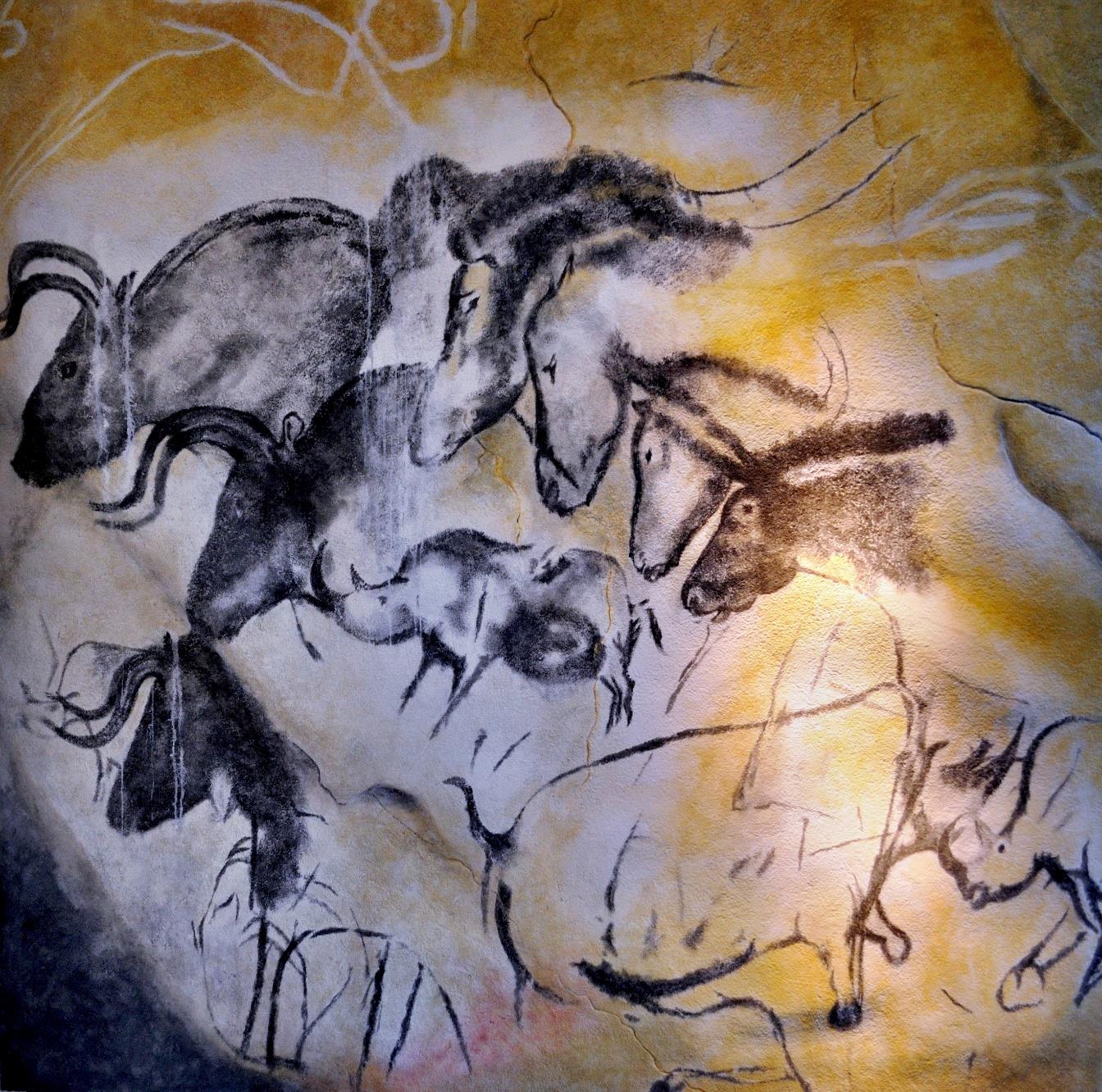
Although human beings are part of nature, it is nature, in its essence, that is the true Other. It is hard to find anything more alien than nature — not in a symbolic sense, not in an allegorical one, nor in an emblematic one. Nature is mortally dangerous and — as bare being — utterly incomprehensible. Without a clear origin and without a creator, a mass of energy rolls before our eyes, aimlessly, in a dance of entropy, towards the unknown future of evolution. It is no wonder that we subjugate it, fence it in and alter it. The human habitus is not the natural environment but the adapted environment of the interiors of dwellings and cities: ordered, manageable, predictable and full of communicative signifiers that lay down taboos, boundaries and instructions for use, even if only as signs for the toilets. Some 40,000 years ago, early humans in the Cueva de El Castillo in northern Spain created moving cave images in which handprints crowd one beside another.2 Eight thousand years later, in the south of France, at the western end of the Alpine arc, the famous cave paintings of various animal species were made in the Chauvet Cave.3 Besides the well-known painting of horses, no fewer than thirteen animal species are depicted, among them deer, bison, lions, panthers, bears, owls, rhinoceroses and hyenas. The paintings in individual caves were made in different historical periods; sometimes we find side by side two images that may have been made thousands of years apart, and not infrequently people retouched or added to a particular image in different periods. In the Lascaux cave, for instance, almost 2,000 depictions of animals, people and abstract signs have been counted. In one of the halls, groups of horses mingle on the walls with images of gigantic bulls.4 “But what is particularly noteworthy is that this tangle of animal forms exists in a groundless (virtual) atmosphere where the bodies are not anchored to anything suggesting land. Rather, what is suggested is a 360° non-Euclidean space, precisely the arrangement of the ideal range of virtuality. There is no attempt at depicting non-virtual Euclidean ground or defining a landscape, and there are no plants, trees or rocks depicted” (Nechvatal, 2011, pp. 73–74).✓
Already in the prehistoric beginnings of art, the environment was the subconscious, undepicted background to representations of the events of life. In the foreground of these expressive efforts were people and animals; the environment was represented by the cave wall itself, with its bulges, reliefs, cracks and the traces of bears’ claws. If we abandon ourselves entirely to speculation, the cave underworld was probably akin to the activity of imagination and daydreaming in the interior of the human spirit. As we can see in Werner Herzog’s documentary about the Chauvet Cave, Cave of Forgotten Dreams, it is entirely possible that the visitors of that time lit a fire in the middle of the halls with the cave paintings, projected their own shadows onto the images of the animals and so enacted stories (Herzog, 2010). On the other hand, the landscape (with its surface and its underground), unlike today, was the ambience of a living space in which a mostly dangerous everyday life took place. Depicting animals on the walls of Lascaux was certainly an experience of palpable risk (Nechvatal, 2011, p. 71), since the artists had to traverse a labyrinth of damp and dark halls in which they encountered deadly animals such as bears and hyenas. They did not do this because they wished to depict a landscape or any other natural environment. The living space of the nature of that time — or rather, of the environment of that time in general — was already the subconscious and conscious background of the first depictions. In his documentary on the Chauvet Cave, Herzog presents an interesting approach of the prehistoric creators. At the spot where, in one of the halls, a cave stream once flowed in through a crack in the limestone, there is the famous painting of horses, beside which a range of other animals is depicted. The surroundings invite the viewer to imagine the painted animals drinking real water. Despite the “abyss of time”, as Herzog calls the temporal gap, we have not lost our imagination over tens of thousands of years of evolution. People today, too, are able to imagine in the cave paintings the environment and ambience in which the depicted animals find themselves. Involuntarily and subconsciously we picture the landscape in which the deer hunt takes place. Our cognitive-perceptual apparatus places it in the background without its being painted at all. Rather than of an absence of the depiction of the environment, or of an absence of aesthetic feeling for it, we can speak (even today) of an all-pervasive overdetermination by it. The environment is a noise that we sometimes perceive, but which is mostly the backdrop of our lives — in exactly the same way as nature. We human beings, with our artefacts, are already in the environment. In the broadest sense, nature is our environment. The aesthetics of the environment is at work all the time; the question is to what extent we are aware of it.
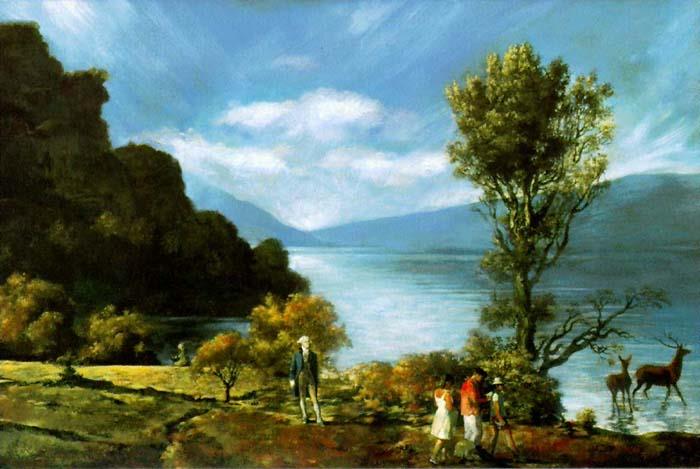
A “taste” for landscape may in fact have persisted in human beings since the Pleistocene. In 1993 the Russian artists Komar and Melamid carried out an unusual experiment under the titles “The Most Wanted Paintings” and “The Least Wanted Paintings”. They hired a public-opinion research agency to conduct a survey of artistic preferences in ten countries in Asia, Africa, Europe and the Americas. The most popular colour was blue, with green in second place (Kreft, 2007, p. 94). Respondents showed the greatest interest in realistic painting. With the help of statistics, Komar and Melamid created the most wanted pattern5 of a painting for each country. “Their intent was clearly ironic, as the painting humorously mixed completely incompatible elements”, explains Kreft (2007, p. 94),✓ while drawing attention to the serious side of the project: although the paintings were created for different cultures, they were remarkably similar. “They looked like ordinary European landscape calendar art, both photographic and painted. It is the calendar industry that has, by meeting market demands, discovered a Pleistocene taste in outdoor scenes. Being a result of evolution inscribed in our aesthetic sense, this taste prefers ‘savannah’, as a safe and nutritious environment for proverbial hunters and gatherers” (2007, p. 94).✓ Inhabitants of different continents, countries and cultural backgrounds thus chose an ideal image: a landscape of green meadows under a blue sky.
As a philosophical discipline, environmental aesthetics together with the aesthetics of nature is roughly five decades old, while the aesthetic appreciation of nature has flourished only over the last three centuries.6 From the first cave paintings to the landscape painting of the eighteenth century, humanity travelled a long stretch of the evolutionary path. I stress from the outset that in this doctoral research I am not seeking merely an answer to the question of why we human beings aesthetically appreciate nature, or why it sometimes seems beautiful to us; above all I am asking how we do this, or how we ought to do it. The aesthetic perception of the environment of everyday life and of natural environments is a fact. We do it in one way or another. The aesthetics of nature is therefore not merely a story about the beauty of nature, but about the question of whether nature, natural phenomena and natural environments have aesthetic qualities, and how, if at all, we can appropriately evaluate them aesthetically. I will be interested above all — and this is the main aim of the aesthetics of nature — in the cases in which the aesthetic appreciation of nature and natural environments is appropriate and those in which it is entirely inappropriate and even misleading. In aesthetics and the philosophy of art there are conventions, rules and conceptual foundations for the aesthetic appreciation of works of art; in the aesthetics of nature there are none (as yet).
Here we must point out a peculiarity in the history of aesthetics. So stubborn an equals sign has been placed between aesthetics and the philosophy of art that someone might think at this point that the aesthetics of nature is in fact the aesthetics of artistic depictions of nature and of natural environments. Quite the contrary: the aesthetics of nature is convinced that it is an aesthetics of natural things, taking place out of doors — beside a tree, in a meadow, on a mountain top or under a clear night sky. In this doctoral dissertation I try to show that, at the present stage of development of the aesthetics of nature, such a (self-)image does not correspond to reality. The philosophical critique of the aesthetics of nature (like the critique of aesthetics and the philosophy of art in general) (still) takes place in texts and with the help of photographs and reproductions, which will be the subject of thorough examination in the chapters that follow. When we speak of depictions of the environment and of nature throughout history, we do not, of course, mean only depictions in paintings, photographs and reproductions. A “depiction” of nature can also be a symbol, a myth, a poem or a text, but in this study we shall devote most attention to images. Why? First, because, in keeping with the heritage of Western art, we live and act with images and through images. The basic mode of existence, communication and action is the image, the sign, the symbol and visual communication. Pictorial messages flood our lives on the screens of computers, telephones and televisions, in the streets, along motorways and in shops. Such overdetermination of everyday life and of the living environment has also left traces in the development of the aesthetics of nature. Further, we can observe that the experience of nature in real life takes place in the imagination, which in most people works by means of — images. In aesthetic appreciation in actual nature, processes of association, imagination, interpretation, contextualisation, anthropomorphisation … and other (often unconscious) psychological processes are at work. Even when we observe nature in vitro, what we take away with us is — an image. The third reason why we concern ourselves so much with images is that the whole aesthetic experience of depictions of nature, whether in a text, a picture, art, cinema or any other genre of depiction, likewise unfolds by means of imaginative envisioning. Photographic depictions of nature, too, as we shall see later, are not transparent.7 For when we look at a photograph of an object, we are supposed to be looking at the object itself in a particular slice of time and from a particular angle. We are supposed to see it at that time and in that place. We are supposed to see the thing itself, which would be entirely different from the appreciation of artistic depictions of nature (and of artistic depictions in general). A photograph would be “the thing as it is”, whereas a watercolour of a natural scene — say, sunrise over wooded hills — would be a collection of patches of colour for which we seek appropriate “transparent” substitutes in our imagination. The watercolour interests us because, as a representation — a collection of patches of colour — it already has aesthetic value in itself; if, however, the photograph is transparent, then as such it would not in itself be worthy of aesthetic interest. Roger Scruton established an interesting distinction between a painted canvas and a photograph: “Here it could not be said that the painting is being treated as a surrogate for its subject: it is itself the object of interest and irreplaceable by the thing depicted. The interest is not in representation for the sake of its subject but in representation for its own sake. And it is such an interest that forms the core of the aesthetic experience of pictorial art and which — if analysed more fully — would explain not only the value of that experience but also the nature and value of the art which is its object. We see at once that such an interest is not, and cannot be, an interest in the literal truth of the picture” (Scruton, 2011, p. 336).✓ In Scruton’s view, ideal8 photographs are not representations, and so we cannot take a genuine aesthetic interest in them — so runs the argument in a very abridged form. The aesthetics of nature is full of ideal photographs, and if Scruton’s argument holds, we cannot speak of aesthetics at all. I will try to show that most photographic depictions of nature and natural environments have the status of representations. As we can see, we face a choice: either we immerse ourselves, on the one hand, in the vast mass of human (artistic) depictions of nature, or, on the other, we set out into nature itself, into an unconquered aesthetic wilderness, and ask what we can aesthetically appreciate and experience there at all. We must do both. Even if we stubbornly walk away from depictions, galleries and the visualised world of the present into the aesthetic wilderness of landscapes, meadows, trees and animals, we are already “infected” with depictions of nature that are in fact silent about nature itself. Above all they cry out about the shadows on the walls of the dark interior of the human spirit — and this we must not overlook.
The relationship between humans and (living) nature is so prominent in numerous myths, tales, fairy tales, legends and fables that many of them can be traced from age to age and from culture to culture, observes Šmitek of beliefs common to humankind, such as the belief that humanity originated from a tree — a belief found not only in many parts of Europe but also in Africa, India, Indonesia, Melanesia, Australia and Central and South America (Šmitek, 2012, p. 54). As elsewhere, Slovenian folk belief also held that trees are living beings that were able to speak at the beginning of the world. It was once said that the forest spoke: when people went to fell a tree, it would say, “Not me — cut down another!” Once everything spoke, everything used to speak; then, when the Lord God came, when he was born, things changed (Dapit and Kropej, 1999, in Šmitek, 2012, p. 54). After God “departed” and humanity was left alone with the troubles it had brought upon itself, the emergence of environmental aesthetics and the aesthetics of nature can also be explained as a response to ever greater environmental problems — yet we must dig deeper, beneath the surface layer of environmentalism. Society for the most part perceives aesthetic interest in nature as a struggle to preserve the beauties of the natural world. As Arnold Berleant argues, recognising aesthetic values in the environment ought to lead to more than opposition to the clear-cutting of forests and the defilement of pristine lakes; aesthetic interest in the environment is more significant than campaigns to clean up the neighbourhood (Berleant, 1992, p. 57). We ought to put into words the beliefs and values that provoke environmentalist efforts in the first place, together with the need for loveliness, cleanliness and order (1992, p. 58), Berleant maintains — aware, at the beginning of the 1990s, that grounding environmental aesthetics in the aesthetics of nature was a philosophical project ex nihilo. Apart from Kant, Schelling, Ruskin and Santayana, philosophers took no interest in the aesthetics of nature. For the most part, philosophical aesthetics turned to nature for the sake of illustrations; it rarely recognised in it an [aesthetic] experience comparable in significance and depth to the experience of art (1992, p. 58).
The aesthetic appreciation of nature appeared relatively late. Eighteenth-century landscape painting, best described by the concept of the picturesque, was so influential that the status of park or pristine wilderness was granted only to those areas which a recognised artist had painted — picturesquely, of course — and of which it could be said that we behold them as if in a framed picture. The picturesque was not only painting but also landscape poetry, gardens and natural scenes of prospects. While Kant was completing the Critique of the Power of Judgment and laying bare the concept of the sublime in the perception of nature, English travellers on the Grand Tour were encountering, for the first time, new kinds of natural landscape — the Alps and the Roman countryside — together with the landscape painting of the French and Italian masters, as Kante points out (Kante, 2009, p. 127). Later, too, in the second half of the eighteenth and the first half of the nineteenth century, the well-to-do travelled to beautiful places and viewed the achievements of local landscape architects. The admiration of landscape went so far that, in their search for picturesque scenery, travellers carried with them a framed Claude glass,9 with which they turned their backs on the landscape and looked at how it would look in a picture (Carlson, 2009, p. 27). As Maillet writes, when the walker possessed neither a painter’s eye nor much money, he could rely on the Claude glass to give him, directly and precisely, the view that a painter would have created (Maillet, 2009, p. 141). The device thus had a democratic dimension: aesthetic pleasures for all, at a relatively low price. Claude glasses and Claude spectacles with lenses of different colours gave walkers and landscape tourists views in nature for which they would otherwise have had to wait, or which would have been entirely beyond their reach. Spectacles with blue or grey glass conjured up in the middle of the afternoon the light that the moon otherwise creates at night. Yellow spectacles served to “create” sunrises and sunsets, since they quickly turned the scene into a reddish twilight without the morning mists suffering any “damage” …
1.1. Hypothesis and Research Questions
If the notion of “natural beauty” seems almost entirely self-evident to us today, for most of Western history it made no sense. As Parsons puts it, to the extent that a landscape was beautiful at all, it was so only when human forces had imbued it with proportion — as when carefully arranged trees, flowers and hedges create a strictly ordered garden (Parsons, 2008, p. 8). Parsons points out that before the eighteenth century reflection on nature as something beautiful and inspiring was absent. The idea of nature as the paradigm of the beautiful practically did not exist. This can be attributed to the classical heritage of thinking about beauty, the inaccessibility of natural areas and the influence of certain religious doctrines (2008, p. 8). Notwithstanding the period of landscape painting, which kindled enthusiasm for the appreciation of nature, the aesthetics of nature as an object of philosophical curiosity then dies away until the middle of the twentieth century. Precisely because of this hiatus, the text in the following chapters concentrates first on the historical moment (and the causes) of the re-emergence of the aesthetics of nature as a field of philosophical inquiry in the 1960s and 1970s, and then looks for the thread that connects the last five decades of the aesthetics of nature.
There is in principle nothing wrong with the fact that the experience of nature in reading texts and perceiving depictions takes place in the imagination, which in most people works by means of images; but such experience is not, in the first place, an experience of nature — it is above all an experience of images in the interior of the human spirit. Just as our ancestors once gathered images of scenes in nature on the walls of caves and passed them on to one another by the light of fires, so today, by the glow of liquid crystals, we gather images of nature and of scenes of the natural environment on the screens of personal computers, tablets and televisions and pass them on via the walls of social networks. The approach is similar to that of millennia ago: we take an image of nature, put it on display and attach various narratives to it.10 They may be environmentalist, aesthetic, philosophical, symbolic, narcissistic, allegorical or naive, but for the most part they are romantic.
In one sequence of his documentary on the Chauvet Cave, Werner Herzog takes the camera from the depictions of animals on the walls up into the air above the landscape around the cave entrance, with the words: “These images are memories of long forgotten dreams. Is this their heartbeat or ours? Will we ever be able to understand the vision of the artists across such an abyss of time?” (Herzog, 2010).✓ The camera’s flight then reveals a typical European landscape of an Alpine river, spanned by an enormous natural rock bridge and surrounded by wooded slopes. “There is an aura of melodrama in this landscape. It could be straight out of a Wagner opera or a painting of German romanticists,”✓ Herzog continues, and asks whether this could be our connection to them. Large trees grow right beside the river. Sunlight makes its way into its valley between the rocky overhangs and the treetops. Above the roaring river, birds in flight draw attention to themselves with loud cries. Such a “staging” of landscape, as Herzog characterises the area around the entrance to the Chauvet Cave, is an “operatic event” that “does not belong to the romanticists alone. Stone-age men might have had a similar sense of inner landscapes and it seems natural that there is a whole cluster of palaeolithic caves right around here” (Herzog, 2010).✓
The inner landscape of contemporary man is an impression — or better, an imprint — that we have acquired by gazing at the “wall” of the computer screen. The default desktop image of the extraordinarily widespread Windows XP operating system, used from 2001 onwards all over the world under different social systems, cultural traditions and world-views, shows rolling green meadows beneath a wonderful blue sky with gentle clouds. Only after thirteen years, when Microsoft officially ended support for XP, did the company reveal the author of the photograph and how it was made.11 The photograph of the famous background, entitled “Bliss”, is pleasant and soothing, yet at first sight so unreal that it was almost impossible to believe it had not been created with a computer program. The truth is quite different. Charles O’Rear, a former National Geographic photographer and the author of “Bliss”, took the photograph in passing, beside a busy road in California’s Sonoma County, north of San Francisco.
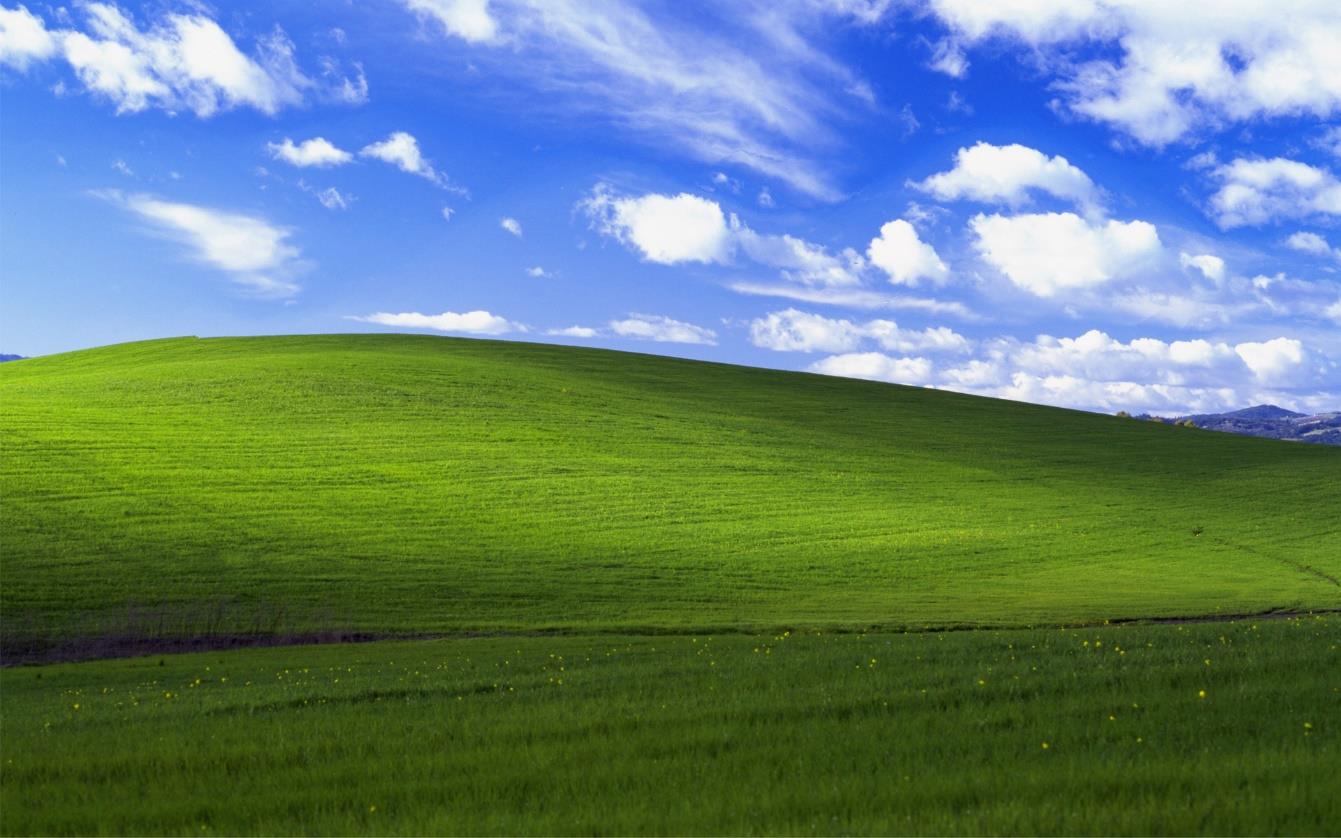
He shot the green hills and the blue sky with clouds on Fuji colour film, which he still had to wind by hand. Even later, when Microsoft discovered it in a stock-photo library, the photograph was not retouched with digital tools. O’Rear notes that he has spotted it both on screens in the White House and in footage from the Kremlin (Luckerson, 2014). The desktop background is so well known and widespread that, according to Microsoft’s estimates, it has imprinted itself on the memory of more than a billion people. O’Rear is even convinced: “Anybody now from age 15 to the rest of their life will remember this photograph” (Luckerson, 2014).✓ Perhaps the landscape photograph “Bliss” really does involve a “taste” that persists from time immemorial — or else a romantic pattern, simply because we know no other. In the end this matters less than the fact that, instead of the Claude glass and spectacles, we now use mass images of this kind. They determine how we must see nature and what we must notice in it. Above all, we view it through the “Windows” of computer screens.
The hypothesis of this doctoral dissertation is that the aesthetics of nature developed as a discipline by means of reproductions, a fact which, with the exception of the aesthetics of engagement,12 has remained largely unreflected in the field. The main object of the aesthetics of nature has in fact not been nature but its photographs (before the advent of the World Wide Web, to a large extent the magazine National Geographic,13 with its perspective of the traveller-explorer), and, with the development of the Web and social networks, other contemporary media14 depictions of natural scenes as well; as a result, most existing models of the appreciation of nature, it seems, are not adequate. The text thus describes the boundaries between the inner landscapes of the spirit and the outer regions of a supposed wilderness, and seeks connections between the Pleistocene taste for landscape and the Romantic explosion of affection for nature. Through the historical milestones in the aesthetic appreciation of nature, the research question of the dissertation seeks answers to the following sub-questions: what kinds of reproductions of nature do we create, to what extent does depicted nature predominate in the aesthetics of nature, and how far into “the thing itself” has the discipline ever ventured? Beneath this surface lie deeper reasons why the aesthetics of nature developed in this way at all and remained (to a certain extent) blind to nature in its actuality, liveliness and self-possession. Among the many examples — some of which we shall encounter in the coming chapters — one important reason may be that in many cases nature is not aesthetically attractive. It is full of distracting factors; it is too fragmented and too scattered. Only when aestheticised into the frame of an image does it become manageable, attractive and pleasing to the taste of the visually pampered eye of the contemporary media.
It can be observed that philosophical efforts to analyse and explain the aesthetics of nature come, in several respects, into conflict with the achievements of human civilisation. The first such conflict concerns the agreement about how far we humans have extended our living space and how the concept of nature ought to be adjusted to that fact. The aesthetics of nature can no longer concern itself only with “nature” on the planet Earth. Since the age of space flight, the boundaries of our natural environment no longer end at the horizon of the ocean, in the distance of a landscape on a mountain ridge, or beneath the clouds in the sky. Kant’s answer to such a claim is that we must take the sky “just as it strikes the eye, as a broad and all-embracing canopy” (Kant, 1999, p. 199).✓ Sublimity lies in the representation which the pure aesthetic judgement attributes to the object; “true sublimity must be sought only in the mind of the judging subject, and not in the object of nature” (1999, p. 96).✓ True enough — but Kant can be understood in his own time and his own place, or better, in his own living environment. The present is different. Our environment — even though we can view the new territories and experience them aesthetically only through images — has expanded from the surface of the Earth, first into orbits around the planet, then to other celestial bodies and into the light-traces of the universe’s past. As early as 1610 Galileo (more or less by chance) learned of the telescope, then built one himself and with it discovered many new facts: for instance, that on the Moon, as on the Earth, there are mountains and valleys, which means that the two bodies are akin in nature; that there is an immeasurable number of fixed stars; that the Milky Way is a cluster of an enormous number of stars; and that Jupiter has four companions … These facts spoke in favour of the Copernican “system of the world”, or at least against the then generally accepted Aristotelian cosmology (Vesel, 2009, p. 13). Galileo’s discovery that not all bodies revolve around the Earth radically shook and changed humanity’s self-image. For the future development of the aesthetics of nature, an important question is also how humanity’s departure into space and its view back at the Earth have influenced the perception of nature, of the environment and of our self-image.15
The first (partial) photographs of the Earth’s surface in 1946, and later in 1966, when Lunar Orbiter 1 photographed most of the planet from a distance of 380,000 kilometres, coincide with the renewed interest of the academic world and of the public in nature and environmental questions. On one of the later missions after the Moon landing, in 1972, the crew of Apollo 17 took what is supposedly the most reproduced photograph in human history, “The Blue Marble”. To date, the Landsat satellite network has taken millions of detailed photographs of the Earth’s surface, and since 1990 the Hubble Space Telescope, placed in orbit at an altitude of 569 kilometres, has been revealing the depths of the universe. Two rovers on Mars have sent humanity panoramic images of the landscapes of the Red Planet. Ever more powerful telescopes are trained on the sky, microscopes on the “ground”, and on the “interior” particle accelerators searching for the “God particle”. An adequate aesthetics of nature must acknowledge that the human living environment has expanded, whereby humanity’s position has been shaken and opened out in all directions. The aesthetic appreciation of landscape beneath the vault of the sky and within the bounds of the horizon, without taking into account the newly conquered landscapes of space, is like the aesthetic appreciation of a re-created landscape in a gigantic greenhouse. “Out there”, and yet at the same time “right beside us”, is the real thing — the wilderness of the twenty-first century, so to speak.
In the years following the Moon landing, discussions and writings about the beauty of nature indeed begin to reappear. Questions begin to be asked about how and why nature is beautiful and under what conditions we can appreciate it aesthetically. In 1966 Ronald Hepburn ended the torpor of the nineteenth and the first half of the twentieth century and, with his article “Contemporary Aesthetics and the Neglect of Natural Beauty”, laid the foundations for the aesthetics of nature (Hepburn, 2006). Although in more than four decades of the development of the aesthetics of nature several (powerless) aesthetic models for the appreciation of nature have been proposed, the view of nature and the discourse on the important questions have not extended beyond the assumption that the object of the aesthetics of nature is exclusively the landscape on Earth. If the Moon is “another Earth”, does that mean that there are people on it? And if there are, how are they descended from Adam? (Vesel, 2007, p. 271). Space, too, is “nature”, and the aesthetics of nature will have to extend its attention to other planets and to the wider space of the universe. The conquest of space has, for the first time in history, given humanity a view and a prospect back onto the Earth. For the first time it was available as a whole. Its mountains, seas and expanses became as tiny as the images on a coin that we hold up to the light to look at them. The Earth itself became a tiny marble on the canvas of the starry sky. The perspective changed from that of the explorer-traveller-documentarist-photographer of the National Geographic Society into the perspective of the astronaut. Man became a being that had stepped out of the earthly landscape and entered the space of the cosmos.
The doctoral dissertation therefore also addresses the question of what parallels and consequences have been brought to the aesthetics of nature by the conquest of space and, at the same time, by the penetration to the smallest building blocks of life at the molecular level and the search for the “God particle”. The dissertation attempts to extend horizontal perception and the aesthetic perspective to the macro- and microcosm, and examines the epistemological and ontological consequences which the introduction of the frog’s-eye and the bird’s-eye view brings for the aesthetic approach. Such an extension of the concept of the aesthetics of nature gives rise to interesting paradoxes, since in space we observe objects that may be only an afterimage, a glint of light travelling towards us, while what we see no longer exists. On the other hand, under the microscope we observe matter that has been torn out of nature (medically or by bioengineering) and in the same instant altered by human hands, and is therefore in danger of not even being “natural” but artefactual. As far as the appreciation of space and the examination of the smallest structures on Earth are concerned, the aesthetics of nature, as reflection on possible experience, comes dangerously close to the field which it tries to avoid by the widest possible margin — the field of art, which does not merely imitate actuality. Today, then, the Claude glass has been replaced by the geostationary satellite in the sky and by the digital camera on the ground, both of which require their captured images to be further processed with special filters in computer programs.
The reproduction or forgery of a work of art, which in most cases does not change it aesthetically, is something quite different from the reproduction of a landscape, a nebula in space or a microscopic image. If we can successfully forge a Rembrandt, we cannot truly forge nature. In this light, photographs as the basic “tool” of the aesthetics of nature, and its other depictions, are not “good images of the Idea”; rather, they feign or simulate this likeness, or make a spectacle out of it. Nature as studied by the aesthetics of nature seems to be a simulacrum (Deleuze, 1998). In its elusiveness it is solely and above all constantly mediated and adapted. We are dealing with its constant depiction and “framing”, whether at viewpoints, in landscape parks, in gardens or in landscape architecture in general. As a society we are blind to the consumerist perception of nature as a shop window from which we can take a beneficial tonic in the form of “natural” food, a view or essential oils. The perception of natural environments is burdened with a romantic consumerism that has a logic entirely its own. Wilderness can exist only as a reserve of unexploited capital, while at the same time it represents a freedom that frees us from determination — one of the fundamental tenets of capitalist ideology. It is an abstraction still to be filled with aesthetic detail: as Morton puts it, wilderness is among the “places you go to on holiday from an administered world”✓ (Morton, 2009, p. 113). The contemporary relationship to nature and its mediation put it “in the shop window” in the form of natural attractions or parks — on display and at our disposal.
It is fitting to note in the introduction that the finding that the aesthetics of nature developed by means of reproductions or depictions is not necessarily a bad thing. In the first place, it was precisely the global flood of images that contributed to the spread of the aesthetic appreciation of nature. The question remains, of course, whether for precisely this reason our “taste” for nature has not remained at the level of the refined and polished photograph.
1.2. Methodology
The topic will be treated through a combination of an analysis of all the more important texts in the field, a critical examination of existing studies, and an analysis of visualisations of nature that substantially influence or co-shape the conception and perception of nature. This means that nature is formed not only as a concept through philosophical discourse but above all as a visual concept, in which the role of eighteenth-century picturesque landscape art as the criterion of “nature” is taken over in the twentieth century by photography and other digital tools. I have studied the phenomenon of mediated images of nature in digital media, with the tools of the World Wide Web and on social networks. I have compared the findings of my research into the procedures of media mediation, the depiction of nature and the manipulability of digital photography with certain philosophical theories and concepts. The primary method was historical-philosophical; in various aspects of the dissertation the research required a comparative, ontological, epistemological and phenomenological approach, and above all the new field of the phenomenology of experience. The scientific relevance of the topic is expressed in a broader field: first in the context in which the conception of nature is relevant to contemporary philosophy, and then also in relation to nature in other disciplines, including the various sciences that carry out practical interventions in nature. For philosophy as a science, the dissertation is relevant in the significance it attributes to visualisation in the formation of the concept of nature — which, for a philosophy that develops predominantly through a verbal-discursive method, represents an important new moment in the way the problem is studied.
1.3. Original Scientific Contribution to the Development of the Field
The first area that offers the possibility of an original contribution to the development of the aesthetics of nature is a reflection on the way in which approaches to the appreciation of nature are studied, seeking to show that these approaches are essentially still similar to approaches in art — which is precisely what the aesthetics of nature has tried to avoid. The dissertation has examined closely the enormous changes in the ways nature is appreciated. Their global spread has been brought about by new technologies, the World Wide Web, the instant convenience of photographs and videos on telephones, and applications for processing them instantly, publishing them and sharing them with others on social networks. New technologies are already on the march that enable constant connectivity, mediation and the placing of the world that we observe, discover and move about in. Such phenomena are a great challenge for philosophy in general and for the aesthetics of nature in particular.
Notes
- The aesthetics of nature is a subdiscipline of environmental aesthetics, or of environmental philosophy. The predominant and most readily accessible literature on environmental aesthetics comes from North America, since in recent decades the discipline has been pursued above all at American and Canadian universities. Because of this we may sometimes have the impression that the problems of the aesthetics of nature and of the environment are distinctly “American”. One example is the frequently raised question of wilderness, through which the newcomers tried, by a kind of aesthetic intervention, to create a national identity and to foster pride. In the cultural landscapes of the Old World the aesthetics of wilderness is somewhat foreign and in a sense superfluous (for the differences between “analytic” and “continental” themes in the aesthetics of nature, see also the chapter on Hepburn and Adorno and the chapter “The Deficient General History of the Discipline”). The same holds for the use of the English term “environment”, which even in the English context is often simply a synonym for nature. By inertia we translate “environment” into Slovenian as okolje, whereby (for historical, cultural and other reasons) most people do not distinguish at all between the natural and the artificial (created) environment. For Slovenians okolje means “nature”, as we can see in journalistic reporting on “environmental change”, “environmental pollution”, “environmentalists” and so on. That for a long time we did not know precisely what we were talking about when we talked about the environment is attested by an episode involving the Slovenian Orthography of 2001, which tried to impose the adjective okolijski in place of okoljski (“environmental”). For a while, journalists of the national radio and television actually used it. In defence of the term okoljski, Dr Helena Dobrovoljc of the Fran Ramovš Institute of the Slovenian Language at ZRC SAZU wrote in the daily Delo that until the publication of the 2001 Orthography, orthographic dictionaries gave information only on the noun okolje, and both the 1950 and the 1962 Orthography directed users to the word miljé; that the word is indeed “young” is also shown by the fact that not even the Dictionary of the Slovenian Literary Language contains an adjectival derivative; at the time the orthographic dictionary was compiled there was not yet sufficiently firm confirmation of predominant usage, which would otherwise be an essential element of the process of standardisation. The form that lives today, and which dictionaries will standardise in the future, is therefore okoljski (Dobrovoljc, 2010). While this dissertation was being written, the second, expanded and partly revised edition of the Dictionary of the Slovenian Literary Language appeared in October 2014. In SSKJ² we find, besides the noun okólje (the material and spiritual world with particular characteristics that surrounds a person // a space with particular characteristics that surrounds a person or thing), also the adjective okóljski (relating to the environment). There is no entry for okolijski. In this doctoral dissertation I therefore consistently use the term aesthetics of nature or aesthetics of natural environments, which is far from meaning the same as environmental aesthetics or the aesthetics of the environment. The environment is a broader concept, encompassing urban spaces, architectural interiors, virtual reality and hybrid environments of the natural and the humanly modified. Where I do not explicitly write about the broader concept of the environment (or those listed above), I always have in mind nature and natural environments. ↩︎
- We know so-called positives, which are imprints of the palm, and negatives, which are coloured outlines of palms and fingers. ↩︎
- The Chauvet Cave was discovered only in 1994, on a private expedition, by the speleologists Eliette Brunel-Deschamps, Christian Hillaire and Jean-Marie Chauvet. Because of its exceptional importance for world cultural heritage, the cave is closed to the public. Access is strictly limited even for scientific expeditions. ↩︎
- It was in the Lascaux cave that the largest depiction of an animal among all cave paintings was found — a bull almost 5.4 metres long (Nechvatal, 2011, p. 73). ↩︎
- The artists also published the questionnaire on the World Wide Web. In the painting most wanted by internet users, a Dalmatian dog sits beside a canvas of contemporary art; in the least wanted, there is a row of books on a bookshelf. Available at http://awp.diaart.org/km/painting.html (accessed 15 January 2017). ↩︎
- Jonathan Maskit divides the aesthetics of nature (and thus, in its early period, environmental aesthetics as well) into three periods: the “golden age” of the eighteenth century, the “years of neglect” in the nineteenth and the first half of the twentieth century, and the period of “enthronement” with Hepburn’s article on the neglect of natural beauty (Drenthen and Keulartz, 2014, p. 41). The years of neglect set in after the fashion for landscape painting in the eighteenth century came to an end, when philosophical interest in nature almost completely died away (which is also what prompted me to begin developing the thesis presented here). Then, after a pause, an unusual revolution occurs. Maskit expressly warns that we must not, and cannot, speak of a “rebirth” of environmental aesthetics, since, as has been said, there was no environmental aesthetics in the eighteenth century (p. 42). In a subchapter below I describe the problematic general history of aesthetics. ↩︎
- In his article “Transparent Pictures: On the Nature of Photographic Realism” (2007), Kendall L. Walton defends the transparency of photographs as opposed to paintings. ↩︎
- According to Scruton’s definition, these show something that actually exists and that is (or was, at the time the photograph was taken) really as it appears in the photograph. Natural scenes in photographs are seldom as they are in nature. For the most part they are stylised, digitally processed and deliberately lit. ↩︎
- To this optical device, which the history of Western art also knows as the “black mirror” (Maillet, 2009), I devote a separate chapter below. Besides mirrors, spectacles with lenses of various colours were also in use. ↩︎
- The “aesthetics” of nature can in fact have entirely conscious, but most often semi-conscious, normative, social and ecological consequences for natural environments. Because of our enthusiasm for picturesque landscapes and for majestic, endearing or charismatic animal species, we often abandon to their fate unattractive but endangered parts of nature, or endangered “unimportant” beings, such as marshes, deserts, insects and the like. Kante, too, draws attention to our tendency to judge the appearance of aesthetically undesirable objects and phenomena as ugly, although our aesthetic judgements often change when our ethical convictions change (2009, p. 70). The maintenance and care of lawns, turf and other green surfaces (golf courses, for instance) has become a global phenomenon. Although the environmental cost of such activity, through the use of water, fertilisers and pesticides, is clear, it occurs in the driest and most impossible areas. ↩︎
- The story of how the “most famous” desktop background in the world was made is also told in a short Microsoft film (MicrosoftNL, 2014). Today the site looks different, since the hills in the photograph are overgrown with vineyards, but it is still a gathering place of sorts for aspiring photographers who try to recreate the photograph and sometimes wait for the “ideal” conditions for it. ↩︎
- Estetika potopitve (literally “aesthetics of immersion”) is my Slovenian translation of the name of the aesthetic approach to nature called the “aesthetics of engagement”, developed by Arnold Berleant. Instead of “immersion”, the terms zavzetost (“engagement”) or prevzetost (“absorption”) are also appropriate in some cases (Berleant, 1992). ↩︎
- We cannot bypass the National Geographic Society, since it is the largest educational geographical society in the world, which in more than 125 years of existence has left a lasting mark and created a “global” taste for nature (Caputo and Burian, 1999). ↩︎
- By the term “media” in this dissertation I do not mean only the mass media, but also other carriers or media, such as printed photographs, images in the form of computer files, sound recordings, television and web footage, and other forms of contemporary audiovisual communication. ↩︎
- At http://spacestationlive.nasa.gov/ the American space agency offers, among other things, a live stream of the view of the Earth from the International Space Station (ISS). Since the ISS circles the Earth every 90 minutes, it is possible to see a sunrise or sunset every 45 minutes. When the station is in darkness, illuminated cities can sometimes be seen on the Earth’s surface. ↩︎