The Elves of Iceland and the Evil in the Woods
In Twin Peaks something evil lives in the woods. The guests from Iceland come from a land with hardly any trees, and they spend the whole party singing.
In the first season of Twin Peaks, the series David Lynch created with Mark Frost, the Horne brothers throw a party at the Great Northern Hotel for a group of Icelandic investors. Pete Martell, the lumberman, stands at the buffet with a full plate and a mug of milk and asks their leader, Einar Thorson, whether his entire country really lies above the timber line. Einar, his mouth full, nods.1
At first it is the joke of a provincial American who cannot imagine a country without timber. In a footnote to my dissertation I argue that it means a good deal more.2
False firs
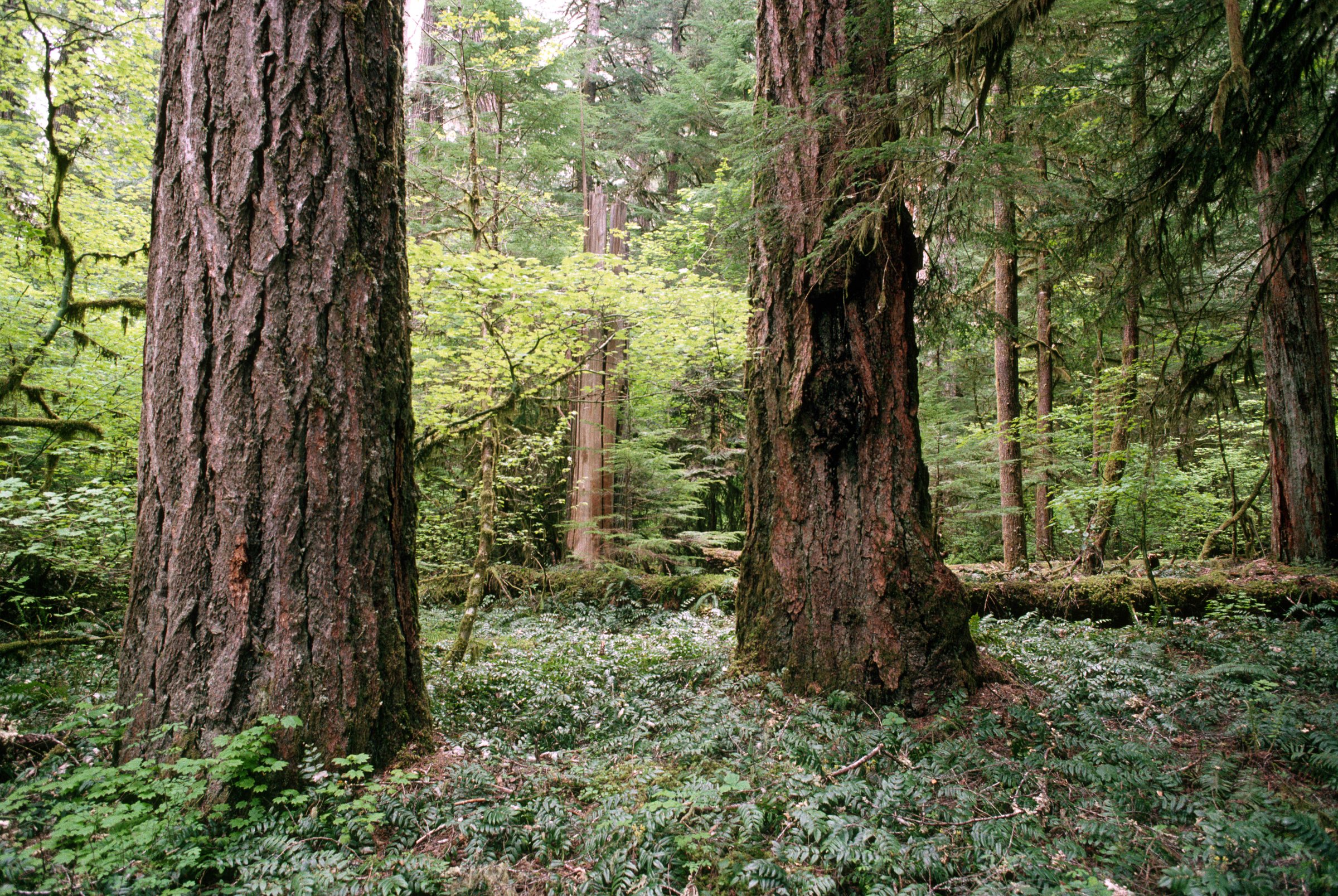
When Special Agent Dale Cooper first arrives in Twin Peaks, he is taken with the mighty trees. They are Douglas firs, Pseudotsuga menziesii, and their name carries the Greek pseudés, false: they are not true firs at all. The people of the town are proud of their forests, which also keep the local economy going, but over time they discover that something dark and evil lives in the woods. The trees are not what they seem. The townspeople are dejected, burdened and gloomy, while the Icelanders, from a land with few trees and therefore little evil, spend their whole visit singing, drinking and enjoying life.
Nature in the heart of culture
Iceland is not empty of invisible forces either. In a 1998 survey more than half of Icelanders said they believed in the huldufólk, the hidden people, and thousands have joined protests against roads and building projects in places where elves are said to live (Jacobs, 2013). The folklorist Valdimar Hafstein reads them as the borderland of the human community: “Elves represent nature in the heart of culture; the places attributed to them are wilderness in the midst of cultivation. These places – rocks, hills, ponds – are taboo, they must not be fished in, messed with, moved or mowed; they must not, that is to say, be brought into culture.”✓3
The word álfar, elves, first appears in records from the Viking Age, some thousand years ago. Ethnologists have collected many testimonies of construction workers who destroyed the dwellings of the elves and then died in strange accidents or had enormous bad luck for the rest of their lives. Most people never see the elves at all; Hafstein spoke at length with seers, who talk to them when there is a dispute or when the elves want to warn people about careless conduct.4
Roads and modernity
Today’s elves, Hafstein notes, are “always directed against development – housing development, infrastructure, factory construction and other projects contributing to urban expansion”.✓ In a small and close-knit society, radio, newspapers and television report on what the elves supposedly think, and the heroes of the most popular stories are road workers. That is no accident. For Hafstein, “Roads are the matrix of modernity. Communications are modernity’s first condition and first priority, its conduits and its concretions. Their development heralds a reconfiguration of space – if the ‘local’ as a category is created through interaction, roads reshape its conditions by transforming and extending interactive space. Road construction, therefore, transgresses the boundaries of the social order that predates it. Roads open up the inside to the outside, bringing others into one’s own domain. They blur the borders maintained in traditional metanarratives of community.”✓5
A road through an elf rock is therefore more than a building dispute. It is the place where the modern world, with its traffic, strangers and new kinds of space, meets the old order of the farm and the parish. For centuries the elves of the tales mirrored the human community. In the twentieth century that community modernised its economy, its population, its means of communication and its culture, but the elves stayed as they were. Seers still describe the clothes, tools and way of life of a pre-industrial peasant society, with no sign of modernisation at all. They are something like the invisible Amish of Iceland. Since the farmer is the paradigmatic Icelander, the elves, as a rural and traditional people, are for Hafstein “a representation of Icelandic cultural identity”.✓6 They also stand for a longing for pristine and true nature, and for a “right” way of living with a contented and happy nature that modernity is felt to have lost.
For me the elves are an aesthetic supplement to the landscape. The bare land of volcanoes, grasslands and rivers is not quite real without them, and where reason cannot explain why a rock must stay where it is, an aesthetics of taboo takes its place: some things are better left to the forces of nature. It is as if the empty land needed a mysterious spice. The elves are a fine specimen of the nature spirits that run through the fairy tales of the European tradition, and the tabooisation of “pristine” nature and wilderness is, in my view, precisely the aestheticisation of such a surplus. Something similar happens in galleries, where people think and experience whatever it is they think and experience. The institutionalised aesthetic experience of nature will not easily shake off the shackles of mythology.
That is why Pete’s question is less foolish than it sounds. Both places tell stories about invisible powers in nature, but the stories work in opposite directions. In Iceland the elves prevent transgression. In the stands of Douglas firs around Twin Peaks, the invisible forces of nature cause it.
Read the full section in the dissertation
Notes
- Twin Peaks, season 1, episode 5, “Cooper’s Dreams”, written by Mark Frost and directed by Lesli Linka Glatter, first broadcast on ABC on 10 May 1990. Pete’s question is paraphrased here. ↩︎
- See the dissertation, chapter 4, note 48. ↩︎
- Hafstein, 2000, p. 89; wording checked against the original, see Sources & translation notes. ↩︎
- On the seers, see the dissertation, chapter 4, note 47. ↩︎
- Hafstein, 2000, pp. 92–94; wording checked against the original, see Sources & translation notes. ↩︎
- Hafstein, 2000, p. 98; wording checked against the original, see Sources & translation notes. ↩︎