Can Space Be Sublime?
Hubble’s deep images gather light for days and show galaxies that may no longer exist. What exactly are we admiring?
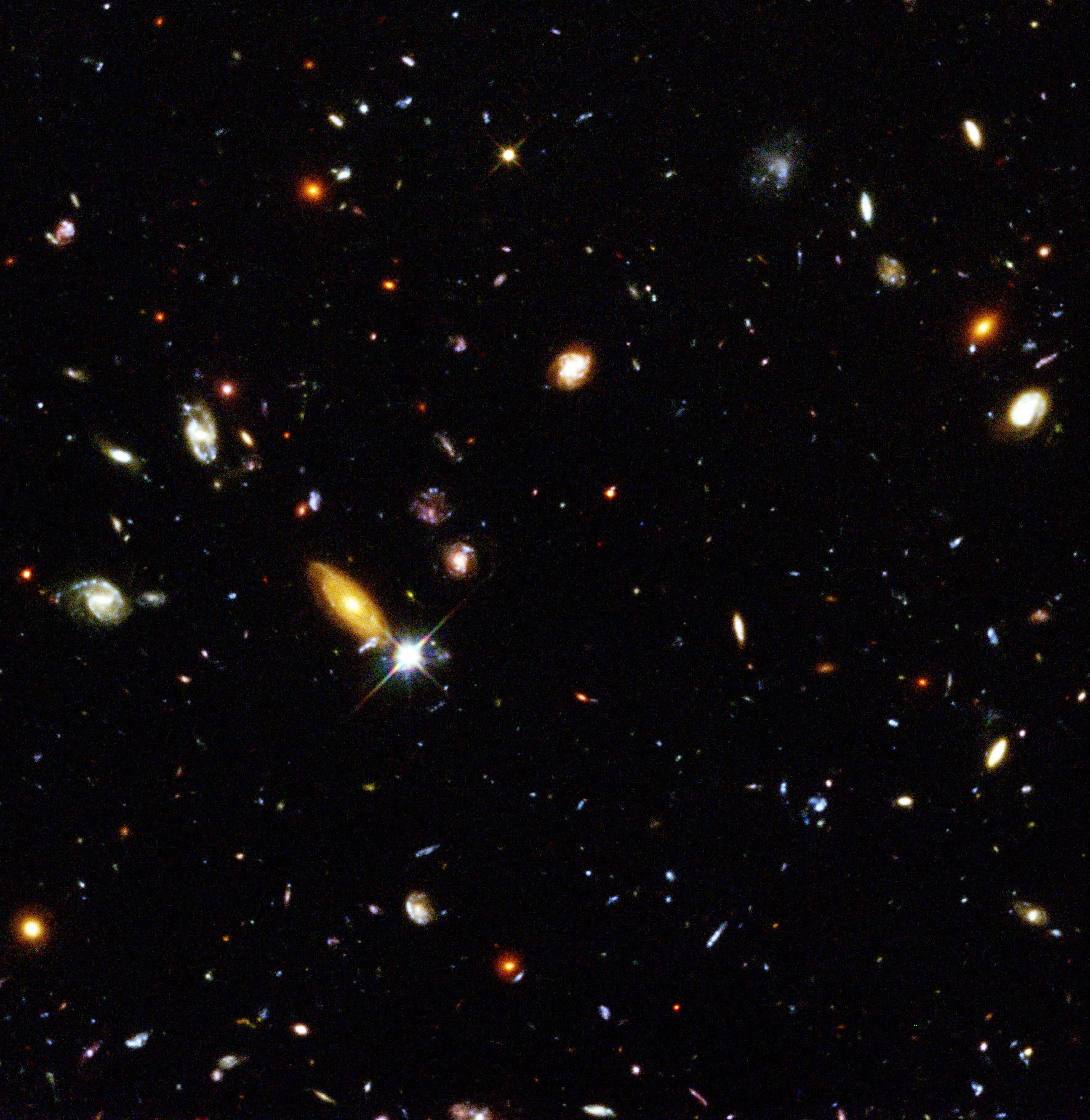
For Kant, the sky was to be taken “just as it strikes the eye, as a broad and all-embracing canopy”,✓ and the sublime was not out there at all: “true sublimity must be sought only in the mind of the judging subject, and not in the object of nature”.✓1 His observer stood safely on the ground and looked up.
What happens when the sky reaches us only as an image? Point a powerful telescope at a tiny scrap of sky, gather light for some ten days, and you can see about ten billion years into the past. The pictures made by space telescopes such as Hubble are not instantaneous shots but hundredfold exposures of small patches of sky that look completely black to the naked eye. Many of the things they show are, in reality, no longer there, or have long since changed.2
A museum of light
Marko Uršič observes that when we look deep into the universe, we look into its past, because light crosses those distances slowly.3 The starry sky is a record of the history of the universe and a reminder of its transience. Which of those stars are still shining, and which are sending us their last light?
Neither beautiful nor sublime
The view of the Earth from orbit sits awkwardly in Kant’s categories too. Astronauts do not report the fearful thrill of the dynamically sublime; they describe something closer to love and dependence. The feeling seems too strong to be merely beautiful, yet it contradicts what holds for the sublime. For now it has no name.
Photographs of deep space are also artefacts in the plainest sense. Lenses capture parts of the light spectrum no eye can see, and without that technology no one would ever have seen these views. Even at the edge of the universe, then, the aesthetics of nature is built with the help of images. Kant relied on a person out walking. We rely on telescopes several metres across. The question of the sublime is still open; only the observer has moved.
Read the full section in the dissertation