America’s Most Wanted Painting
Two artists asked people in ten countries what they wanted to see in a painting. Nearly all of them asked for the same landscape.
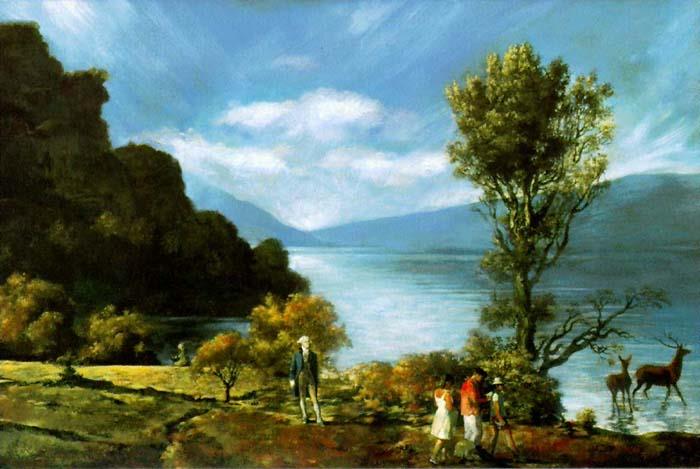
In 1993 the Russian artists Komar and Melamid carried out an unusual experiment under the titles The Most Wanted Paintings and The Least Wanted Paintings. They hired a public-opinion research agency to survey artistic preferences in ten countries in Asia, Africa, Europe and the Americas, and then used the statistics to paint the most wanted picture for each country.1
The answers were plain. Blue was the favourite colour, green came second, and realism was preferred. Lev Kreft, who supervised my dissertation, points out that the artists’ intent was clearly ironic, since “the painting humorously mixed completely incompatible elements”.✓ When the questionnaire went online, the internet’s most wanted painting showed a Dalmatian sitting beside a canvas of contemporary art; its least wanted, a row of books on a shelf.2
The serious side
The joke has a serious side. Although the paintings were made for different cultures, they were remarkably alike. In Kreft’s words, “They looked like ordinary European landscape calendar art, both photographic and painted.”✓ He suggests that the calendar industry, by meeting market demand, had discovered a taste for outdoor scenes going back to the Pleistocene: an evolved preference for savannah-like land, safe and nourishing for hunters and gatherers.3 People from different continents thus chose the same ideal image, green meadows under a blue sky.
Innate or learned?
A taste for landscape may well have persisted in us since the Pleistocene. But the same green and blue also fill desktop wallpapers, stock libraries and calendars. If the inherited taste is real, the image industry has learned to serve it so well that we can hardly tell inheritance from habit.
That is why, in the dissertation, I am less interested in why such scenes please us than in how we look at nature, and how we ought to. The most wanted painting may tell us less about nature than about the pictures we have been shown of it.
Read the full section in the dissertation
Notes
- Kreft, 2007, p. 94. ↩︎
- See the dissertation, chapter 1, note 5. ↩︎
- Paraphrased from Kreft, 2007, p. 94; the quoted wording is checked against the original English, see Sources & translation notes. ↩︎